
Grwpiau

Southern Railways
About the group Southern Railways covers any railway location within the Southern Railway territory, including industrial, military railways etc.
Wedi ei greu 27 June 2012

IvanS |
||
|
Hassocks station visible in the background
|
tomoliver |
|
|
Lewes station, goods yard and now demolished bridge loop towards Uckfield
|
tomoliver |
|
|
An all Maunsell train - A Mogul with a seven set (or a three and four set) and a utility van on the rear. A new roof going on the LT sheds and both prefabs and new housing being built in the bombed areas. I believe this area of London had as much bombing as any.... often suffering the tale end of payloads dropped from flights making their way home from the city.
|
Maurice |
|
|
I would be interested Maurice, how you could have identified the "Maunsell" train and that the loco was an "N" or "N1" class mogul. You must have extremely good eyesight, from "our" distance, or perhaps I'm missing something!
|
Wilmington |
|
|
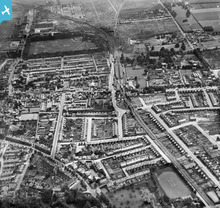
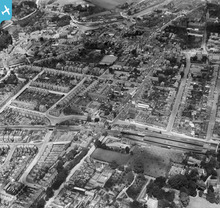
Showing Keymer Junction, Wivelsfield station
|
tomoliver |
|
|
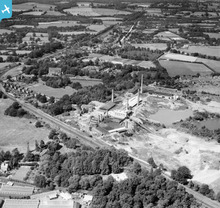
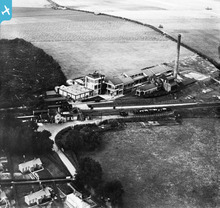
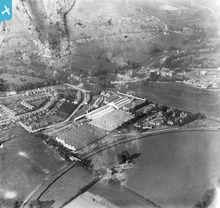
Lewes Cement works showing detailed track layout
|
tomoliver |
|
|
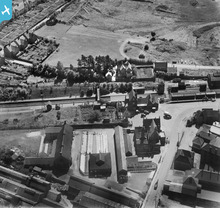
Hassocks station and gas works
|
tomoliver |
|
|
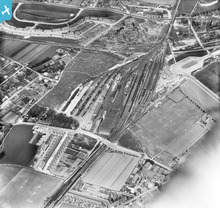
Lewes station is to the top of the photo showing the old Goods run around.
|
tomoliver |
|
|
Oakley station, Hampshire on the lswr main line to Exeter. View from line side in the middle far distance only viewable if you zoom in.
|
David |
|
|
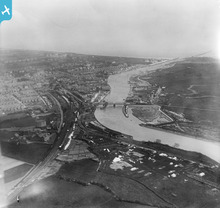
Newhaven stations in 1931
|
tomoliver |
|
|
The Southern Railway's Southampton Docks development. 1932
|
Maurice |
|
|
Another shot of Derriton Viaduct - Holsworthy
|
Maurice |
|
|
Holsworthy East Viaduct on the original line from Okahampton. Viaduct built of natural stone - not precast concrete as suggested in this picture's captions.
|
Maurice |
|
|
Holsworthy Derriton Viaduct on the Bude extension - precast concrete blocks
|
Maurice |
|
|
Nice photo of Havant Station.
|
John Russell |
|
|
Additional comments on picture in main collection 22/09/12
|
Maurice |
|
|
Shot of Portsmouth showing the closed East Southsea station, see the pin for details.
|
tomoliver |
|
|
Crawley town, station and goods yard.
|
tomoliver |
|
|
Also shows the station and line from Tipton St John.
|
Maurice |
|
|
Shoreham town centre with the line going towards Worthing and below it is the now disused line to Beeding cement works, Bramber, Steyning. This line is now a cycle path and the Steyning bypass!
|
tomoliver |
|
|
Epsom EPW006480
If you follow the footpath between the shops with awnings from the clock tower northwards one comes to the broad station forecourt. Here we find a station with two long platforms for the trains of the London and South Western Railway. Running through the middle of the station are two tracks of the London Brighton and South Coast Railway. These cross the down line from Waterloo coming in from the top of the picture, curving away to the east side (right-hand side) and Epsom Town Station. On the amalgamation of the railways in 1923 (eighteen months after this picture was taken) Epsom became an example of how the new Southern Railway made some relatively simple efficiency savings and improvements to connectivity by building one station at the junction of its two constituent railways. This was also repeated at Leatherhead - see image EPW001718. In Epsom the stations were at opposite ends of the High Street, the ‘Brighton’ station being found in EPW006486 and EPW006487. The new station, built about four years after the picture was taken, required the creation of two island platforms, one for up trains and one for down services, connected to a street level booking office by lifts and stairs. The timetable was arranged so cross platform connections could be made in either direction. Trains often left simultaneously to Waterloo and Victoria or London Bridge and followed as closely as possible going south, the Dorking train departing first. Passengers for Ashtead or Leatherhead would jump off an Effingham train from Waterloo to arrive three minutes earlier on the train that had come from Victoria. Later in the 1950s and 1960s this move was often accompanied by the station announcement that the train was for “As’tead, Leather’ead, Box’ill, Dorking, ’Olmwood, H-Ockley, Warn’am and ’Orsham.” The arrangement seen in the photograph was the result of competition in the building of the railways, while the arrangement today benefits from the coordination, planning and cooperation with the ensuing efficiency of the network. Leatherhead EPW001718 At the top of this picture the two viaducts over the River Mole bring the London and South Western railway curving in from Effingham Junction alongside the London Brighton and South Coast Railway from Dorking. The line passes through two parallel stations before joining somewhere near the right hand (northern) side of the picture for the journey to Epsom - see image EPW006480. Shortly after the amalgamation of the railways in 1923 (two and a half years after this picture was taken) the new Southern Railway made some relatively simple efficiency savings and improvements to connectivity by using one station at Leatherhead. The lines were joined as soon as they came off the viaducts and all trains used what had been the ‘Brighton’ on the line nearest the photographer. The LSWR station remained for many years, with the tracks being used as carriage sidings, the building becoming a maintenance liability. These developments brought about effective change that offered a better service to travellers, even if they did not maximise income for the railway by realising the value of the land and buildings no longer required at Leatherhead. |
Maurice |
|
|
basingstoke and alton light railway (lswr) running horizontally with sidings to thorneycroft motor works and railway wagons in yard.
|
David |
|
|
seaton railway station bottom right and axmouth harbour and bridge
|
rog747 |
|
|
Stockbridge Station (Andover to Romsey line)also known as
Sprat and Winkle line |
Brian |
|
|
On the Atlantic Coast Express route in the 60's
|
Brian |
|
|
Eastbourne station in the distance
|
tomoliver |
|
|
Railway Carriage Works, Lancing,
|
tomoliver |
|
|
Hove station and extensive goods areas
|
tomoliver |
|
|
Another shot of Littlehampton station
|
tomoliver |
|
|
Littlehampton station, goods yard and surrounding area
|
tomoliver |
|
|
Faversham Station and Engine Shed (at the top of the image).
|
John Russell |
|
|
This photo clearly shows the main station,and the engine shed.
|
Peter Smart |
|
|
Faversham Station
|
John Russell |
|
|
Lots of interest here with the main station on the left hand side.
|
Peter Smart |
|
|
This view shows the Reading line curving in front of Dennis Bros factory.
|
Peter Smart |
|
|
Andover Town Station with Level Crossing
|
Brian |
|
|
Ramsgate Station
|
John Russell |
|
|
John Russell |
||
|
Charing Cross Station
|
John Russell |
|
|
Guildford Sation and Engine Shed at the top of this image.
|
John Russell |
|
|
John Russell |
||
|
Part of Guildford station lower left.
|
Roger Traviss |
|
|
Guildford station off to the left.
|
Roger Traviss |
|
|
Lymington and what's that in the platform?
|
Roger Traviss |
|
|
Another view of Ryde Pier Head station.
|
Roger Traviss |
|
|
Ryde Esplanade Stataion
|
Roger Traviss |
|
|
Roger Traviss |
||
|
Southampton Terminus top RH corner.
|
Roger Traviss |
|
|
Emsworth Station
|
Roger Traviss |
|
|
Lynton Station right hand middle of image
|
treaders |
|
|
A Picture of Tonbridge Station in 1920 - amazingly not a lot has changed!
|
Mark Herriott |
|
|
One thing that has changed (and there are several others) is that the station platform awning no longer carries the inscription TONBRIDGE. Such identification was provided by the Southern Railway in an age when early aviators used to follow railway lines to reach their destination.
|
Maurice |
|
|
Great view of Axminster Station.
|
John Russell |
|
|
Yes! I have posted this photo too below and have added some 'pins' on there for a bit of local insight.
|
rog747 |
|
|
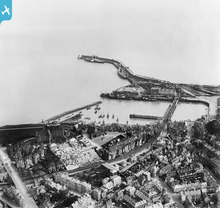
And another view of the Harbour line and Station from the North-west looking out across the channel with steamers awaiting their passengers.
|
rog747 |
|
|
nice view of Folkestone Harbour Railway Station.
|
rog747 |
|
|
An even clearer image of a LSWR station on the West of England main line at Gillingham Dorset.
This view is sharper than Axminster. |
rog747 |
|
|
Rather unique view showing the full goods yard of Brighton and the Works.
|
tomoliver |
|
|
I am hoping soon the archive will add something of Dorchester South Station.
I cannot find any photos on the web at all of this station prior end of steam. If anyone can put me in the direction of any photos that would be very cool. Thanks |
rog747 |
|
|
A wonderful study of late 1920's station life at Axminster,
note the local bus waits outside and lots of good yard activity. |
rog747 |
|
|
Just joining the group Russell. Brian George SEMG
|
Brian |
|
|
Check out the "pins" for more info.
|
John Russell |
|
|
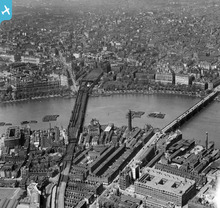
Near the bottom, you can see a turntable and a steam engine being turned, This turntable was known as Belevedere Road.
|
John Russell |
|
|
Cannon Street Railway Station with overall roof.
|
John Russell |
|
|
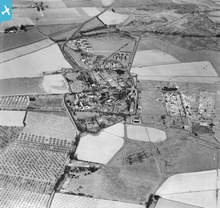
Terminus of Kingsnorth Light Railway KLR), which connected this refinery to the SER (later SR) at Sharnal Street. KLR was opened in 1915 and closed around 1950. Locos used were a Kerr Stuart 0-4-0ST and petrol shunters.
|
John Russell |
|
|
Nice shot of the original Cannon Street station with the overall roof still in place.
|
John Russell |



























see image record